
2026 · MARITERRO FOOD SOLUTIONS
Not all processed food is harmful. The real issue begins when food is engineered rather than simply prepared.
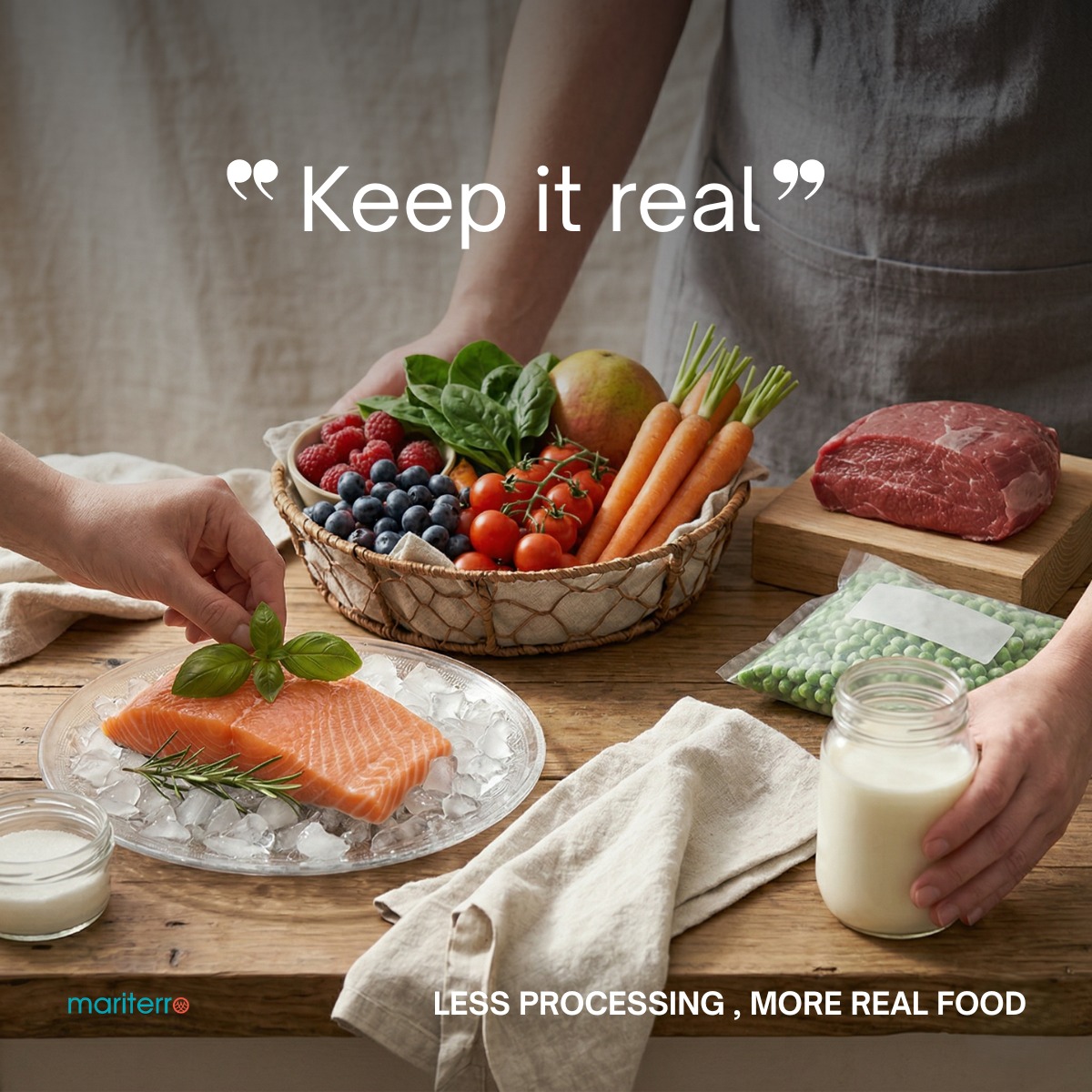
Minimally Processed Foods (MPFs) are foods that remain close to their natural state. They undergo basic preparation methods—like cleaning, cutting, chilling, or pasteurization—without altering their core structure or nutritional integrity.
PART ONE
The Definition: What Minimal Processing Actually Means
Minimally Processed Foods — MPFs — are foods that remain close to their natural state. They undergo basic preparation methods without altering their core structure, nutritional profile, or biological composition. The processing that occurs is in service of the food: making it safe, accessible, and preservable. It is not in service of an industrial objective such as shelf life extension, addictive palatability engineering, or cost reduction at the expense of nutritional value.
The Permitted Processes
What distinguishes minimal processing is not the absence of any intervention, but the nature and intent of the intervention. The following processes fall within the definition precisely because they do not alter the fundamental character of the food:
• Cleaning and washing — removing surface contaminants without affecting nutritional integrity
• Cutting and portioning — altering physical form without chemical or structural change
• Chilling and freezing — extending biological freshness through temperature control alone
• Pasteurisation — applying controlled heat to eliminate pathogens without synthetic additives
• Drying and smoking — traditional preservation methods that maintain the food’s natural composition
Minimally processed food is food that has been prepared, not redesigned. The distinction is not one of degree — it is one of intent.
Common Examples of Minimally Processed Foods
The category is broad, familiar, and — crucially — accessible. Fresh fish and seafood handled and chilled at point of harvest. Fruits and vegetables cleaned and portioned for retail. Clean-cut meats that have undergone no reformulation. Pasteurised milk in which no synthetic ingredients have been introduced. Whole grains, nuts, and legumes processed only to remove inedible outer layers.
These are not specialist health products. They are the foundational foods that human populations consumed long before industrial food processing existed — and which the scientific consensus now consistently identifies as the nutritional baseline for long-term health.
PART TWO
Minimally Processed vs. Ultra-Processed: The Line That Matters
The contrast between minimally processed and ultra-processed food is not a spectrum. It is a categorical distinction — one that separates preparation from industrial reformulation. Understanding where that line falls is essential for consumers making informed choices, and for industry participants who intend to be on the right side of where global food regulation and consumer demand are heading.
Where Ultra-Processing Begins
Ultra-processed food crosses the line the moment a food product’s design becomes decoupled from the nutritional properties of its source ingredients. Industrial formulations introduce artificial additives, synthetic preservatives, flavour compounds, texture stabilisers, and refined ingredient complexes that have no analogue in nature. The resulting product may bear a superficial resemblance to real food — in colour, texture, or taste — but its biological relationship to whole food has been fundamentally severed.
→ Nutritional value: Ultra-processed foods systematically strip natural nutrients and replace them with synthetic approximations that the body handles differently.
→ Gut health impact: Artificial additives and emulsifiers in ultra-processed formulations are directly linked to degradation of the gut mucosal barrier and disruption of the microbiome.
→ Appetite regulation: Ultra-processed products are specifically engineered to override natural satiety signals — a design feature, not a side effect.
→ Ingredient transparency: The longer the ingredient list, and the further removed individual ingredients are from recognisable food sources, the greater the degree of ultra-processing.
If the food could not have existed before industrial chemistry, it is not minimally processed. The test is simple: could a cook have made this with recognisable ingredients and basic preparation?
Why the Distinction Has Regulatory and Commercial Consequences
The MPF/ultra-processed distinction is no longer solely a matter of consumer preference. Regulatory frameworks across the EU, UK, and increasingly in major Asian markets are moving toward mandatory classification and labelling based on degree of processing. Institutional buyers — from hospital procurement networks to premium retail chains — are explicitly building MPF-sourcing requirements into their supplier criteria. For food businesses, this is not an abstract positioning question. It is a commercial and compliance question with an accelerating timeline.
PART THREE
Why It Matters — Nutrition, Traceability, and the Future of Food
The case for minimally processed food rests on three pillars that reinforce each other: the nutritional superiority of foods that retain their natural composition; the transparency advantage that fewer processing steps create; and the role of traceability infrastructure in making the MPF promise verifiable at scale.
Nutritional Integrity as the Foundation
Minimally processed foods retain essential nutrients in their most bioavailable form — the form that millions of years of human biology evolved to absorb. Fibre remains structurally intact. Vitamins and minerals have not been depleted by high-heat industrial processing. Natural enzyme activity is preserved. Cellular structures that govern the rate of nutrient absorption have not been dismantled. These are not marginal advantages. They are the difference between food that actively supports physiological function and food that merely provides calories.
Transparency as a Value Multiplier
Fewer processing steps mean a shorter, more legible supply chain. In a world where consumer trust in food systems has been significantly eroded by decades of undisclosed additives, opaque ingredient sourcing, and misleading health claims, the simplicity of a minimally processed food product is itself a form of value. When a consumer or a buyer can verify what a product is, where it came from, and what was done to it — and that answer is short and honest — the product commands a premium that no amount of branding can replicate.
Traceability as the Enabling Infrastructure
Digital traceability is the system that makes MPF claims verifiable rather than merely asserted. It tracks food from its point of origin — the vessel, the farm, the harvest date — through every step of handling, transport, and processing to the final consumer. For minimally processed foods, this infrastructure is particularly powerful: the fewer the processing steps, the more directly the traceability system can link quality at the point of consumption to conditions at the point of origin.
The future of food is simple: less processing, more real food. Not as a slogan — but as a verifiable, traceable, scientifically grounded commitment.
The Direction of Travel
The global food system is moving — unevenly, but unmistakably — toward fresh, minimally processed, and transparently sourced food. This movement is being driven simultaneously from the demand side, by increasingly informed consumers; from the regulatory side, by governments responding to the public health consequences of ultra-processed diets; and from the supply side, by producers who have recognised that value is created in what you preserve, not in what you add.
Choosing minimally processed foods is not a lifestyle statement. It is a return to the biological fundamentals of what food is for: to nourish, to sustain, and to support the body’s own intelligence — not to override it. Less processing. More real food. That is where the future of global nutrition is being built.
Tell us more about your requirement.
Our Team will get touch with you in 24 Hours