
2026 · MARITERRO FOOD SOLUTIONS
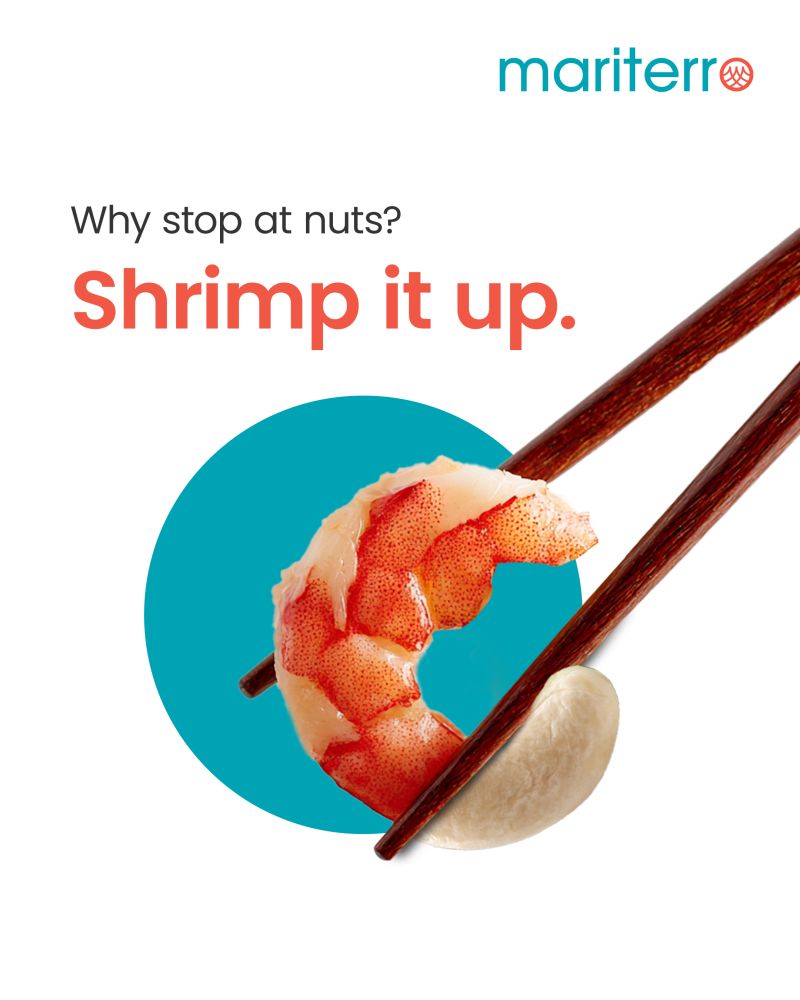
Despite their biological differences, shrimp and cashew nuts share notable similarities — particularly in their culinary versatility, their outsized role in India’s food economy, and their status as two of the country’s most significant agricultural export commodities. Which powerhouse dominates India’s market: the coastal shrimp or the versatile cashew nut? The answer is more complex and more fascinating than it might first appear.
PART ONE
The Nutritional and Environmental Comparison
Any honest market comparison between shrimp and cashew nuts must begin with what they actually deliver — nutritionally and environmentally. The numbers are instructive, and in several respects, counterintuitive.
Nutritional Profile: A Closer Look
Both shrimp and cashew nuts are widely regarded as excellent protein sources — but a closer examination of the data reveals meaningful differences that matter for consumer health positioning and dietary guidance.
→ Protein content: Shrimp delivers approximately 24g of protein per 100g, compared to 18g for cashews — a significant advantage for those prioritising lean protein density.
→ Omega-3 fatty acids: Shrimp is a meaningful dietary source of Omega-3 fatty acids, associated with cardiovascular and neurological health benefits. Cashew nuts are not a primary source of Omega-3s.
→ Micronutrient profile: Shrimp provides vital micronutrients largely absent from cashews — most notably iodine, essential for thyroid function, and Vitamin B12, critical for neurological health and red blood cell formation.
→ The cholesterol question: A common concern around shrimp is its dietary cholesterol content. However, shrimp is very low in saturated fat, and the scientific consensus increasingly indicates that dietary cholesterol from shrimp does not negatively impact blood cholesterol levels for most people. The historical concern was overstated.
Shrimp is not merely a protein source. It is a nutritionally dense, low-fat food that delivers micronutrients — iodine, B12, Omega-3s — that cashews simply cannot match.
Environmental Footprint: The Carbon Comparison
Sustainability is an increasingly decisive factor in global food purchasing — by consumers, by institutional buyers, and by regulators. Here, shrimp holds a significant and underappreciated advantage.
The average carbon footprint of farmed shrimp is approximately 13kg of CO2 equivalent per kilogram of product. For cashew nuts, that figure is approximately 36kg CO2e per kilogram — nearly three times higher. For a food category positioning itself on sustainability credentials, this differential is not marginal. It is a structural competitive advantage for shrimp that the industry has yet to fully leverage in domestic market communications.
PART TWO
Who Eats What — and Why the Market Looks the Way It Does
Understanding the current market dynamic between shrimp and cashew nuts in India requires understanding not just what people eat, but why the supply chain has been structured around export rather than domestic consumption — and what that means for the future.
The Price Reality
In the Indian market, high-grade cashews are consistently priced higher per kilogram than most varieties of fresh shrimp. This price differential has historically positioned cashews as a premium snack and ingredient category, while shrimp has remained a relatively accessible protein for coastal communities — but has not penetrated national retail at anything close to the scale its nutritional profile and price point would suggest.
Consumption Patterns: The Cashew Advantage
On domestic consumption volume, cashews are the clear winner. Their versatility across snacking, confectionery, and regional cuisines — combined with their ambient shelf life, which eliminates cold chain dependency — has driven widespread national consumption that shrimp has never achieved at scale.
The context here is significant: approximately 72% of Indians are non-vegetarian, representing a potential consumer base for shrimp that is enormous by any measure. Yet shrimp consumption remains heavily concentrated in coastal states. The gap between the theoretically addressable market and actual domestic consumption is the central commercial question facing India’s shrimp industry.
72% of India is non-vegetarian. India is one of the world’s largest shrimp producers. The domestic shrimp market should be enormous — and it is not. That gap is not a mystery. It is an opportunity.
The Export Orientation Problem
India’s shrimp industry has been built almost entirely around export. The infrastructure, the certification frameworks, the cold chain investment, and the processing capacity have all been calibrated for international buyers — primarily in the US, EU, Japan, and Southeast Asia. Domestic retail has been, at best, an afterthought.
The contrast with cashews is stark. India is the world’s largest consumer of cashew nuts, with a very high proportion of both domestically produced and imported cashews being sold within the country. The cashew industry built a domestic market. The shrimp industry, with equivalent or superior product advantages, largely did not.
PART THREE
Unlocking Future Growth — The Policy and Market Agenda
The domestic shrimp market is projected to reach $22.7 billion by 2033 — and that projection assumes no significant promotional intervention. With deliberate policy support, market development investment, and structural reform, the ceiling is substantially higher. The question is not whether the opportunity exists. It is whether the will to seize it does.
The Policy Levers That Matter
→ Agricultural integration: Integrating aquaculture into the broader agricultural framework would give shrimp farmers access to the subsidies, insurance mechanisms, and regulatory protections currently available to land-based agriculture — dramatically improving production economics and farmer resilience.
→ Tax reform: Reducing the GST on frozen shrimp from 5% to zero would directly improve affordability at the retail level, reducing one of the structural barriers to mainstream domestic consumption.
→ Domestic promotion: A sustained, well-funded campaign positioning shrimp around its nutritional credentials — protein density, Omega-3 content, micronutrient profile, and low carbon footprint — would begin to close the awareness gap that currently suppresses demand in non-coastal markets.
→ Tariff war mitigation: Building a robust domestic market provides India’s shrimp industry with structural insulation against global trade disruptions, export bans, and tariff volatility — risks that an exclusively export-oriented industry is permanently exposed to.
India does not need to choose between being a world-class shrimp exporter and building a world-class domestic shrimp market. But it does need to start treating the domestic market as a strategic priority — not an afterthought.
The Opportunity in Plain Terms
The comparison between shrimp and cashew nuts is ultimately a comparison between two industries that started with similar raw advantages — strong production base, significant domestic consumer potential, export credibility — and made different strategic choices about where to focus. Cashews built a domestic market. Shrimp exported everything it could.
The nutritional data favours shrimp. The carbon footprint favours shrimp. The price-to-protein ratio favours shrimp. The demographic profile of Indian consumers — 72% non-vegetarian, increasingly health-conscious, increasingly urban — favours shrimp. What has not yet favoured shrimp is the deliberate, sustained, policy-backed market development effort that would translate those advantages into domestic consumption at scale.
That is the agenda. The data is already making the case. For a full breakdown of the analysis, the comprehensive report is available at: Click here
Tell us more about your requirement.
Our Team will get touch with you in 24 Hours