
2026 · MARITERRO FOOD SOLUTIONS
How Ultra-Processed Foods Rewire the Brain
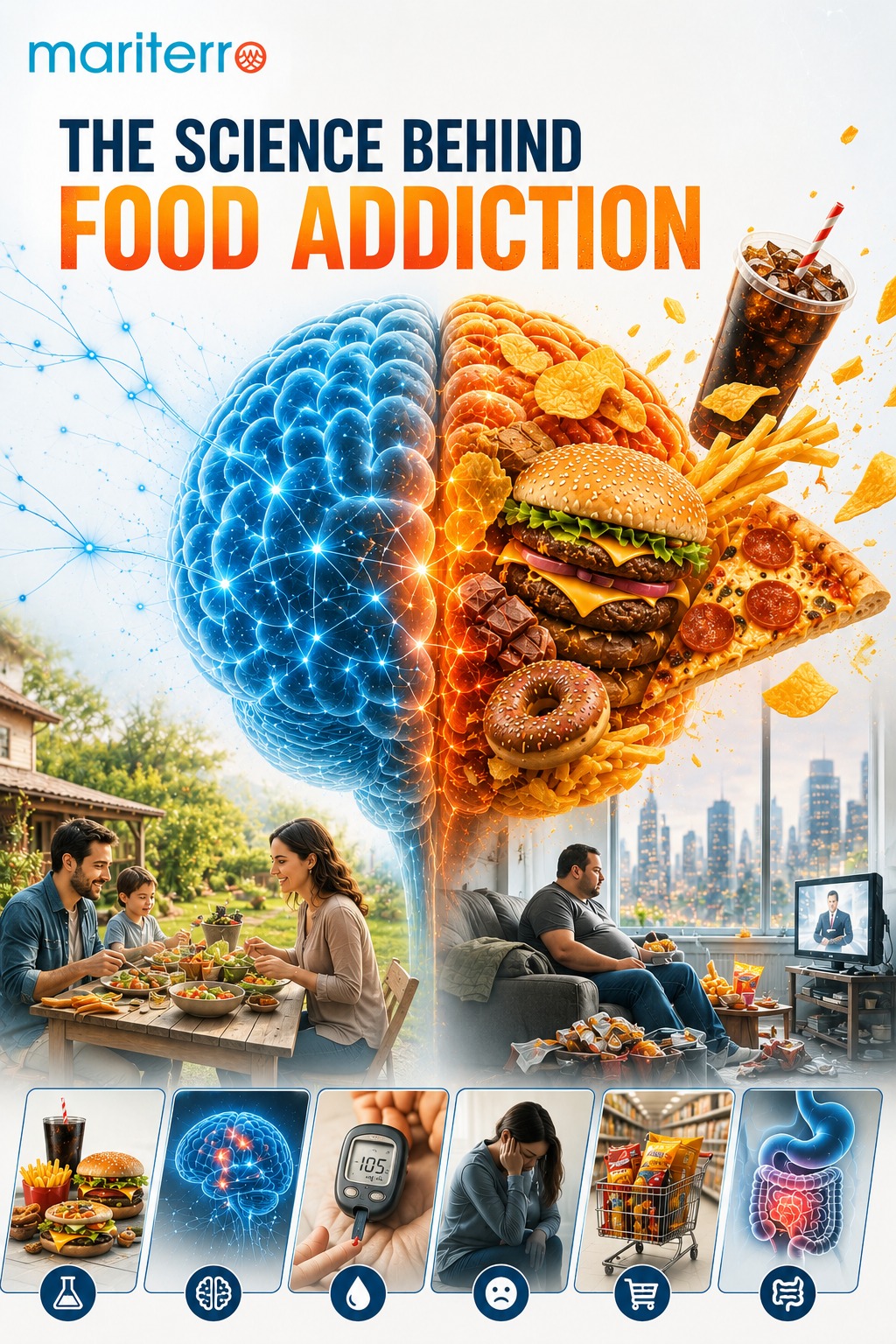
We have all been there: intending to eat one cookie and ending up at the bottom of the bag. While we often blame a lack of willpower, science reveals a more calculated culprit. Food addiction is not a personal failing — it is the result of sophisticated food engineering designed to bypass our natural fullness signals. Modern ultra-processed foods are literally changing the way our brains function. Here is how it happens — and how you can take control back.
PART ONE
What Ultra-Processed Foods Are — and Why They Are Different
Before we can understand how ultra-processed foods affect the brain, we need to be precise about what they are. Not all processed food is harmful. The danger begins at a specific point on the processing spectrum — where preparation ends and industrial reformulation begins.
The Definition
Unlike minimally processed foods frozen spinach, canned legumes, chilled fresh fish ultra-processed foods (UPFs) are industrial formulations. They are constructed from substances extracted from foods: fats, starches, and added sugars, then laced with additives including emulsifiers, artificial flavour enhancers, synthetic preservatives, and texture stabilisers. The resulting products bear a superficial resemblance to food but have been fundamentally decoupled from the nutritional properties of any whole-food source ingredient.
Common ultra-processed foods include sugar-sweetened sodas and energy drinks, packaged snacks and instant meals, sweetened breakfast cereals, and industrially reconstituted meats. What they share is not a category of flavour or function it is a method of manufacture that prioritises shelf life, palatability engineering, and cost reduction over biological compatibility.
Ultra-processed foods are not simply convenient food. They are industrial products designed to simulate food — and to override the signals that real food would trigger.
PART TWO
The Dopamine Trap: How Processed Food Rewires the Brain
The $16 gap in tuna pricing is created in the 30 minutes after harvest. The gap between a healthy diet and a UPF-dominated one is created in the neurochemical cascade that follows each consumption event. Understanding this mechanism is not a matter of nutrition philosophy. It is neuroscience and it explains why individual willpower is an inadequate response to a system-level biological problem.
How the Reward System is Hijacked
The human brain is wired to reward calorie-dense fuel with dopamine the neurochemical that drives motivation, pleasure, and reinforcement. Historically, this ensured survival: finding a calorie-rich food source was a genuine achievement that warranted a reward signal. Ultra-processed foods exploit this ancient system by delivering an unnaturally concentrated hit of stimulation a dopamine response that real food, however nutritious, was never designed to produce at that magnitude.
The Cycle That Creates Dependency
→ Overstimulation: Repeated UPF consumption floods the brain’s reward circuits with dopamine at levels that natural foods cannot match.
→ Receptor downregulation: The brain protects itself from overstimulation by reducing the number of active dopamine receptors the same adaptive mechanism observed in substance dependency.
→ Tolerance: With fewer receptors available, greater quantities of UPFs are required to produce the same level of reward, driving escalating consumption.
→ Craving: When UPF consumption drops, dopamine levels crash below the new baseline. The brain interprets this deficit as urgent need, generating intense cravings.
→ Satiety bypass: UPFs are engineered to reach a precise ratio of salt, sugar, and fat a formulation optimised to override the hormonal signals that tell the body it is full.
This is not a failure of personal discipline. It is the predictable neurological outcome of a system designed by calculation, not accident to produce exactly this result.
PART THREE
The True Cost and How to Reclaim Your Brain
The consequences of UPF-driven neurological disruption extend far beyond the individual moment of overconsumption. They accumulate biologically, financially, and socially into a public health crisis that is both preventable and, in large part, manufactured.
The Health and Economic Consequences
The obesity crisis is not simply a calorie problem. It is a metabolic dysfunction problem one in which UPF-centred diets drive systemic inflammation, insulin resistance, and hormonal dysregulation that persists long after any individual meal. The downstream consequences are direct and documented:
→ Chronic disease: High UPF consumption is directly linked to Type 2 diabetes, cardiovascular disease, and metabolic syndrome conditions that are both expensive to treat and largely preventable.
→ Gut microbiome disruption: UPFs lack dietary fibre and introduce additives that degrade the gut mucosal barrier, driving systemic inflammation that affects every organ system.
→ Mental health: Diets high in UPFs are associated with significantly elevated rates of anxiety and depression a consequence of both neurochemical disruption and gut-brain axis dysfunction.
While convenience food appears cheap at the point of purchase, the true cost includes escalating medical expenditure, lost productivity from chronic fatigue and illness, and the compounding social burden of diet-related disease. The food industry externalises these costs onto individuals, healthcare systems, and economies. Consumers pay twice: once at the checkout, and again in the clinic.
Practical Steps to Break the Cycle
The brain is neuroplastic. The same adaptability that allows UPFs to reshape reward circuitry also enables that circuitry to recalibrate when the input changes. The transition does not require perfection it requires consistency and a clear understanding of what you are working with.
• Read labels with intent: if a product has more than five ingredients, or contains words that require a chemistry background to decode, it is almost certainly a UPF.
• Crowd out rather than ban: instead of eliminating foods through willpower alone, focus on adding protein and fibre both of which support satiety and reduce the neurochemical space available for cravings.
• Make deliberate swaps: replace sugar-sweetened drinks with sparkling water; replace processed snacks with whole foods like Greek yogurt, nuts, or fresh fruit.
• Allow time for recalibration: research consistently shows that two to four weeks of reduced sugar and salt intake is sufficient for taste sensitivity to begin resetting toward natural flavours.
The food industry may have engineered a biological vulnerability. But the brain is resilient. Every deliberate choice to eat real food is, at the neurochemical level, an act of reclamation.
The Takeaway
Food addiction is not a character flaw. It is the documented, predictable outcome of an industrial food system that has invested decades of scientific effort into maximising neurological dependency. Understanding the mechanism does not make resistance easy but it makes it possible. By choosing whole and minimally processed foods, you are not simply eating better. You are systematically restoring the brain chemistry that ultra-processed food was designed to disrupt. What is one small swap you can make in your kitchen today?
Tell us more about your requirement.
Our Team will get touch with you in 24 Hours