
MAY 2, 2026 · MARITERRO FOOD SOLUTIONS
By Rajesh Kumaramenon, Co-Founder & Director, Mariterro Food Solutions Pvt Ltd
India holds one of the world’s richest yellowfin tuna grounds — yet the majority of its catch is sold at commodity prices that barely cover fuel costs. The gap between what India earns and what it could earn is not a fishing problem. It is a protocol problem, a compliance problem, and an infrastructure problem. All three are solvable. And the opportunity they unlock is measured in billions.
PART ONE
Every year, Indian fishermen bring in tens of thousands of tonnes of yellowfin tuna — Thunnus albacares — primarily as bycatch from our vast Exclusive Economic Zone. This is the identical species commanding $40 per kilogram at the sashimi counters of Tokyo, $35 per kilogram at Rungis market in Paris, and $30 per kilogram at US premium importers. On Indian shores, the same fish sells for approximately $2 a kilogram.
That is not a margin. That is a 9x to 20x pricing collapse — and it happens before the fish ever leaves our coast.
To understand the scale of the opportunity being squandered, consider just a few data points. The United States alone imported $161 million worth of fresh and chilled yellowfin tuna in 2024 — overwhelmingly from Panama, Costa Rica, Australia, and Suriname. The European Union imported 141,660 metric tonnes of yellowfin in 2023, a figure that has grown 117% over a decade. Japan imported 213,826 tonnes of tuna in 2024. These are not marginal numbers. This is one of the world’s most actively traded premium commodities.
India’s scientifically estimated harvestable yellowfin tuna potential within its EEZ runs into tens of thousands of metric tonnes annually — yet actual landings meeting international export-quality standards represent only a fraction of what is biologically possible and economically viable. The gap is not in the ocean. It is in what we do after the catch
India’s tuna is largely treated today as it has always been: a commodity needed for the cannery sector, sold in bulk, iced in rudimentary conditions, and exported at the lowest tier of market value. We are, in effect, treating Blue Gold as scrap metal. And we are doing so by choice — by the absence of choice, actually — because the infrastructure, protocol, and compliance ecosystem that unlocks premium value simply does not exist at scale in India’s fishery today.
The global fresh and chilled seafood export market is estimated at $245.3 billion. India — with its 2.02 million square kilometre EEZ, its significant fleet, its proximity to Indian Ocean tuna grounds, and its strategic deep-sea fishing expansion — captures a negligible fraction of the premium segment. Every season this continues, it is a permanent, unrecoverable loss of national income and fishermen’s livelihoods.
PART TWO
The $16 per kilogram difference between Indian commodity tuna and sashimi-grade premium tuna is created in a very specific window: the 30 to 60 minutes immediately after a fish is landed on deck. This is where value is either locked in or destroyed. India, at present, largely destroys it.
Let us be honest about what this means in practice, and about the specific systemic gaps that create this outcome.
The Post-Harvest Protocol Gap
When a large pelagic fish like yellowfin tuna is brought aboard in the conventional way — thrashing, stressed, exhausted from the fight — an acute physiological cascade begins. Stress hormones flood the bloodstream. Cellular energy reserves deplete at a rate that fundamentally alters the texture and flavor potential of the muscle tissue. Bacterial proliferation accelerates. Histamine — the compound that regulators in Japan, the US, and the EU specifically test for — begins forming within minutes.
Premium buyers in Japan, Europe, and the United States will not accept a fish that has gone through this process. They can measure it: in the pH of the flesh, in the ATP levels, in the color of the muscle, in the smell of the blood. There is no hiding it.
Achieving premium grade requires an entirely different approach to the moment of capture — one that interrupts the stress response immediately, preserves cellular energy, removes blood rapidly from the flesh, and places the fish into a precisely controlled thermal environment within a short window. This must happen on deck, at sea, every time. India has no standardised, industry-wide protocol for this. The vast majority of our tuna catch is iced in bulk with no protocol whatsoever. This single gap eliminates us from the premium market before any other consideration applies.
The Compliance and Traceability Gap
Even perfect post-harvest handling is insufficient without the compliance architecture that premium global markets now mandate. Consider what an Indian exporter must provide to access the top tier of the international tuna market:
India’s artisanal and mechanised fishing fleet operates almost entirely outside these documentation systems. There is no boat-to-plate digital passport. No real-time GPS tracking linked to export documentation. No objective, standardised quality grading at point of harvest. These are not bureaucratic hurdles — they are the entry requirements for a market worth hundreds of millions of dollars. Without them, Indian tuna cannot access that market.
The Cold Chain and Fleet Infrastructure Gap
The third systemic gap is the most capital-intensive: the physical infrastructure of cold chain and vessel capability. Premium fresh and chilled tuna has a shelf life measured in days. From the moment of capture to the moment it reaches a sashimi counter in Tokyo or a premium retailer in London, the entire biological clock is running. Maintaining value within that window requires superchilling — not bulk ice — at precisely controlled temperatures, combined with biosensor packaging that actively monitors the freshness state of the product in real time.
India’s fishing infrastructure is built around bulk ice and ambient fish holds. There is no superchilling capability at scale on Indian fishing vessels. And critically — the most common mechanised fishing boats operating along the west coast run on 200 HP engines, which are not adequate for true deep-sea tuna fishing. Yellowfin tuna in premium concentrations requires going significantly further offshore, which requires vessels with substantially greater engine power, seakeeping capability, and onboard preservation systems. These vessels simply do not exist in meaningful numbers in India’s tuna fleet.
The government’s recent opening of deep-sea fishing access is a positive step on paper. But paper policy without the physical fleet to execute it — and without the onboard infrastructure to preserve what the fleet catches — will not unlock value. It will only send underpowered vessels further offshore to catch fish that will still be sold at commodity prices.
The future of Indian marine fisheries — particularly tuna — does not lie in catching more fish. It lies in innovating the fishing method, targeting value-creating species, and capturing the full economic value of every single fish that comes aboard. India needs to stop fishing for volume and start fishing for value.
These gaps are real. But none of them are permanent. Each is a solvable engineering and policy challenge. And the combination of solving all three would unlock an opportunity for India that is genuinely transformative — not incremental.
What Government Must Do
Policy leadership is essential. India needs a standardised national tuna quality protocol, backed by MPEDA and CMFRI, mandating scientifically sound post-harvest handling as a condition of export certification. Government subsidy programmes should be restructured to prioritise onboard superchilling infrastructure over vessel count. Geographical Indication (GI) tagging for Indian tuna from specific ocean zones — similar to what has been done with Darjeeling tea or Alphonso mango — would create a premium provenance narrative that global buyers are actively willing to pay for. And vessel upgrade support, specifically for engine power adequate for genuine deep-sea operations, would put the fleet where the premium fish actually are.
What Investors Must Recognise
The blue economy is among the most underinvested asset classes in India relative to its potential. The capital required to build the post-harvest protocol infrastructure, cold chain, digital traceability, and processing capability is not enormous — but it is specific, and it requires patient investors with sector understanding. The returns, however, are documented and compelling. A protocol-driven tuna operation, properly capitalised, can achieve net margins of 36-49% at the shipment level on the same raw material that currently sells at near-zero margin. The Serviceable Addressable Market for India in the premium fresh and chilled tuna segment alone is measurable in thousands of crores. This is an early-stage infrastructure investment with a genuine moat — because biology, compliance, and traceability infrastructure cannot be replicated quickly by a new entrant once established.
What Industry Must Execute
Processors, exporters, and food companies across the Indian seafood sector must move beyond volume thinking. The market for premium Indian tuna — traceable, sustainably caught, scientifically handled — exists right now in Europe, the US, Japan, and the Middle East. Buyers in these markets are not waiting for Indian supply to improve; they are sourcing from Panama, Sri Lanka, and Australia instead. Every year that Indian industry does not build the protocol and compliance infrastructure to compete, it cedes ground in a market it could own.
The Arithmetic of What Is at Stake
If India were to capture just 3 to 5 percent of the global fresh and chilled yellowfin tuna import market at sashimi-grade pricing, the annual export earnings from this single species would represent thousands of crores. Add value-added processing — loins, steaks, saku blocks, sushi-grade portions — and the multiplier effect is substantial. This is not a speculative projection. It is arithmetic applied to documented global trade flows, documented price differentials, and documented Indian tuna stock potential. The opportunity is real, it is large, and it is currently being harvested by countries that have simply taken the trouble to handle their fish better than we do.
At Mariterro Food Solutions, we have spent the last several years building the infrastructure to close these gaps. From training artisanal fishermen in proven post-harvest protocol to deploying digital traceability that creates a verified identity for every fish we handle — Phase 1 of our model is already validating the export market, establishing buyer relationships, and demonstrating that Indian tuna, when handled correctly, commands premium prices.
Phase 2, however, is where this story changes at scale.
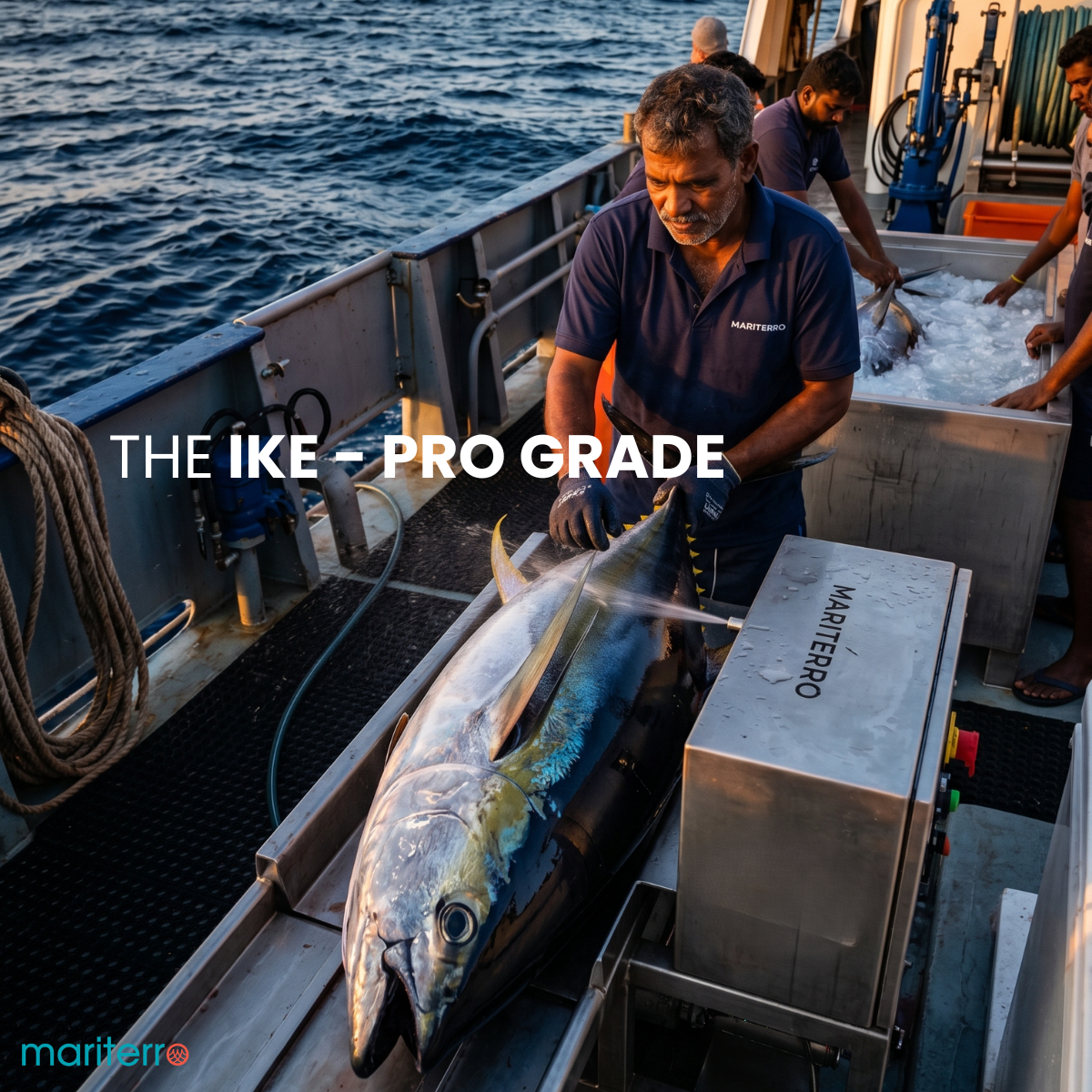
We are on the verge of deploying what we believe is the most significant piece of fisheries technology ever engineered for the deck of an Indian fishing vessel — a fully automated system designed for the specific spatial constraints and operational realities of our fleet, capable of executing a complete, scientifically calibrated post-harvest protocol at industrial speed with no compromise on biological quality.
We call it Ike Pro. It runs a complete cycle in 30 seconds. It processes up to 120 fish per hour. And it is about to transform what Indian tuna boats can do — and what Indian tuna is worth.
On this World Tuna Day, as the global premium market waits for a new origin to step up, India’s moment is at hand. Ike Pro is how Mariterro intends to seize it — for the fishermen who catch the fish, for the communities that depend on the sea, and for India’s rightful place at the global premium table.
Watch this space.
Tell us more about your requirement.
Our Team will get touch with you in 24 Hours